
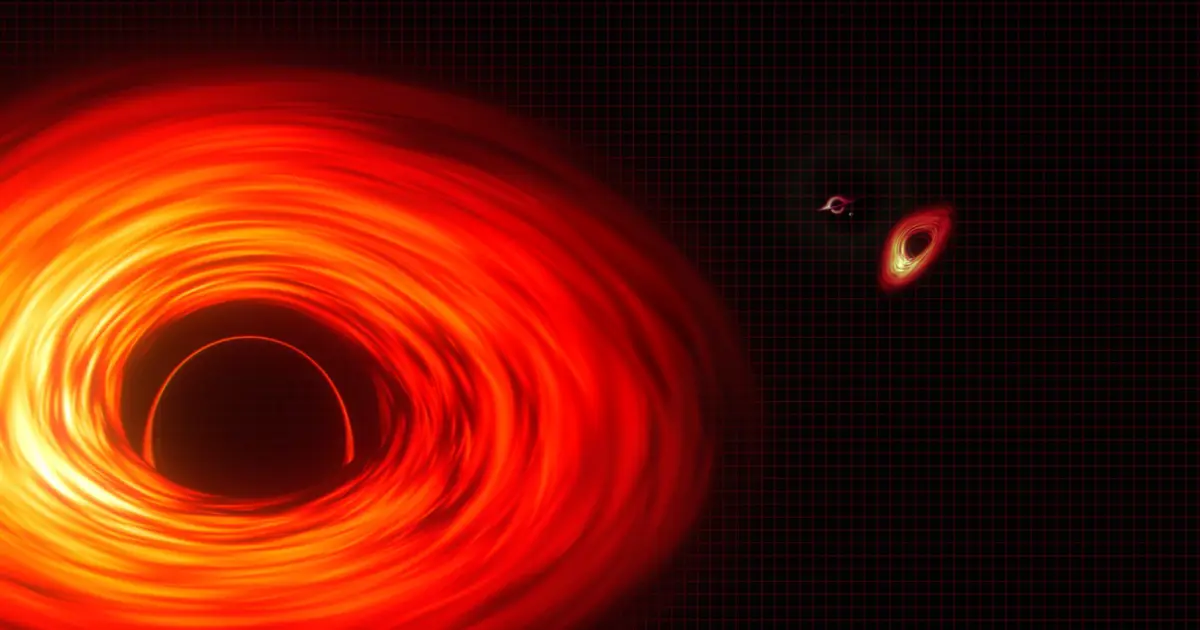
For over a century, physicists have theoretically understood that rotating black holes should drag the fabric of space around them. However, directly observing this effect had remained impossible—until now. Thanks to the violent “death” of a distant star, astronomers have successfully observed this cosmic “stirring” in real-time for the first time.
A Star’s Fatal Encounter Reveals Cosmic Secrets
The event began when a star ventured too close to a supermassive black hole. Through a process known as a “tidal disruption event,” the star was torn apart, feeding its material into the black hole. This event, cataloged as AT2020afhd, transformed into a natural laboratory for testing one of physicist Albert Einstein’s strangest predictions from general relativity: that rotating, massive objects drag spacetime itself along with them, creating a slow vortex.
By monitoring rhythmic fluctuations in X-rays and radio waves emitted from the stellar remnants, scientists obtained the clearest evidence yet that a black hole truly warps and twists the fabric of spacetime around it. This effect is known as Lense-Thirring precession.
Tracking the Fabric of Spacetime
Tidal disruption events are inherently chaotic by nature. As the star approaches the black hole, it stretches and disintegrates, with the resulting gas forming a bright accretion disk around the black hole. In some cases, jets of matter are launched from this disk at speeds approaching the speed of light.
What made AT2020afhd particularly special was precisely this characteristic. Astronomers monitoring the event noticed that X-ray brightness increased and decreased by more than tenfold at regular intervals. This cycle repeated every 19.6 days. Shortly afterward, radio telescopes detected the same rhythm.
The critical point was the synchronized “wobbling” of these signals. The X-rays and radio waves changed in perfect coordination.
Study co-author Cosimo Inserra from Cardiff University explained: “This study provides the most convincing evidence yet for Lense-Thirring precession. Just as a spinning top drags water around it in a vortex, we’re seeing the black hole drag spacetime along with it.”
Synchronized Signals Reveal Hidden Geometry
This synchronized fluctuation showed scientists they weren’t witnessing a random flare. Rather, the disk formed from stellar remnants and the outward-shooting jet were slowly changing direction due to the effect of spacetime warped by the black hole’s rotation.
To capture this behavior, the team combined data from NASA’s Neil Gehrels Swift Observatory, which monitors X-rays, with observations from various radio telescopes, particularly the Karl G. Jansky Very Large Array.
Einstein Proven Right Once Again
Einstein first pointed to this effect in 1913, and a few years later, Austrian physicists Josef Lense and Hans Thirring established its mathematical foundation. However, observing spacetime dragging near a black hole had proven extremely difficult until now.
On scales closer to Earth, satellites had detected very small versions of this effect. Near black holes, the effect should be much stronger, but distinguishing it within the extremely chaotic environment presented a major challenge.
This study succeeded in overcoming this chaos by using stellar remnants as a kind of “tracker.” As the accretion disk underwent precession, its visible area changed, causing fluctuations in X-rays. As the jet oriented toward and away from Earth, radio brightness increased and decreased. Together, the two signals revealed the invisible geometry of warped spacetime.
A Gift to Physics
Inserra stated: “This is a real gift for physicists. We’re confirming predictions made over a century ago. At the same time, these observations increase our knowledge about the nature of events where a star is torn apart by a black hole’s tremendous gravitational pull.”
AT2020afhd demonstrated that a black hole can literally drag spacetime, transforming an abstract theoretical prediction into an observed phenomenon.
The research findings were published in the journal Science Advances.
-

-

-

-
